
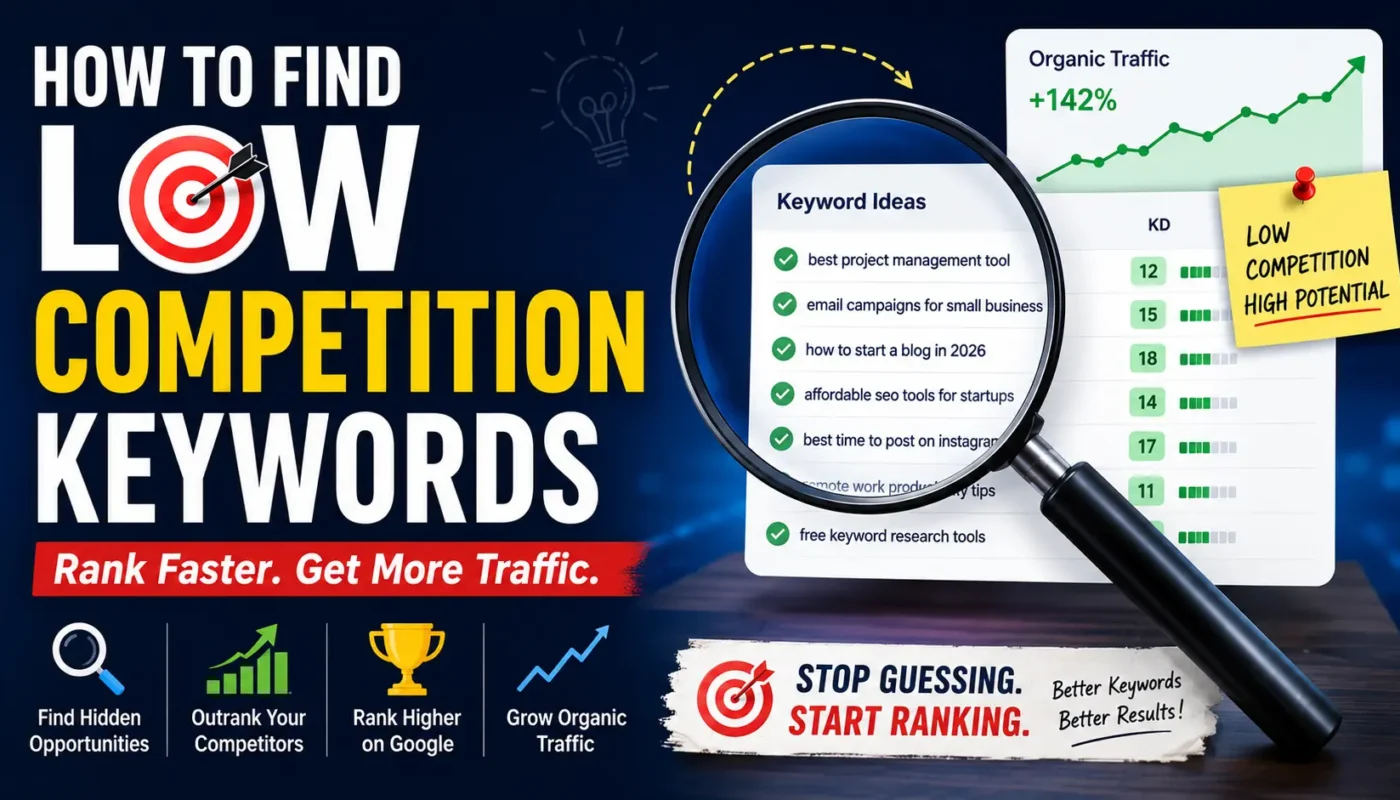
Do you publish useful articles but struggle to rank because large websites already dominate your target keywords? Stay calm because you do not always need high-volume or highly competitive phrases to attract valuable search traffic.
Low-competition keywords often focus on specific questions, audiences, locations, problems, or goals. They may attract fewer searches individually, but they can bring visitors who know exactly what information they need.
Learning how to find low-competition keywords helps you identify realistic ranking opportunities, create focused articles, and reach relevant readers. This approach can support new websites, small businesses, niche blogs, and writers who cannot compete with major brands immediately.
This guide will explain how to understand search intent, choose a clear niche, discover long-tail phrases, study search results, analyze competitors, evaluate keyword difficulty, and select opportunities that support your content goals.
How to Find Low-Competition Keywords
Low-competition keywords usually attract fewer strong competitors or contain a more specific search need. They give smaller websites an opportunity to create a more focused and useful answer.
You should not choose a keyword only because a tool labels it as easy. You also need to review relevance, search intent, ranking pages, content quality, and business value.
The following methods can help you find realistic keyword opportunities:
- Understand Search Intent
- Choose a Focused Topic
- Start With Seed Keywords
- Find Long-Tail Keywords
- Use Search Suggestions
- Study Related Questions
- Analyze Search Results Manually
- Review Competitor Keywords
- Check Keyword Difficulty Carefully
- Look for Weak Ranking Pages
- Combine Keywords With Audience Needs
- Validate Keywords Before Writing
1. Understand Search Intent
A practical online content writing course can teach you how to connect keyword research with the reader’s real search intent. You should identify what people want before you compare search volume or competition.
Search intent explains the purpose behind a keyword. A person may want information, a specific website, a product comparison, or a direct purchase.
Search your potential keyword and review the type of pages that appear. Notice whether the results include articles, videos, category pages, product pages, tools, or local businesses.
Match your planned page with the dominant intent. Do not write a general blog post when users clearly want to compare products or complete a purchase.
A keyword may show low competition, but it will not help you when its intent does not match your website or offer. Relevance should guide your final decision.
Review these search-intent types:
- Informational: The user wants to learn something.
- Navigational: The user wants to find a particular website or page.
- Commercial: The user wants to compare products, tools, or services.
- Transactional: The user wants to buy, register, download, or contact.
- Local: The user wants a nearby business, service, or location.
- Problem-based: The user wants to solve a specific difficulty.
2. Choose a Focused Topic
A broad topic can produce thousands of difficult keywords. A focused topic gives you a smaller and more relevant group of opportunities.
Start with your website’s main subject. Then divide it into categories, customer problems, skill levels, formats, industries, and specific goals.
For example, content writing covers a broad field. You can narrow it into SEO articles, website copy, email writing, product descriptions, editing, or freelance writing.
You can narrow each category further. Product description writing may include clothing descriptions, technology products, beauty products, or handmade goods.
A focused topic helps you create stronger keyword groups and more complete articles. It also helps search engines understand the main subjects your website covers.
Narrow a topic through:
- Audience type
- Skill level
- Industry
- Content format
- Specific problem
- Desired result
- Product category
- Geographic location
3. Start With Seed Keywords
A seed keyword describes the basic topic that you want to research. It gives you a starting point for finding longer and more specific phrases.
Choose simple terms that match your products, services, audience, or website categories. A writing website may begin with phrases such as blog writing, SEO content, or freelance writing.
Do not judge a seed keyword by competition yet. Use it to discover questions, variations, and related topics.
Create several seed keywords for each important category. This approach gives you more directions to explore.
Add customer language whenever possible. Customers may describe a problem differently from industry professionals.
Record your seed terms in a spreadsheet or research document so you can organize later findings.
Seed keyword sources include:
- Main services
- Product categories
- Website sections
- Customer questions
- Industry terms
- Common problems
- Desired results
- Competitor topics
4. Find Long-Tail Keywords
Long-tail keywords contain more detail than broad search terms. They often describe a specific audience, question, problem, or desired result.
For example, SEO represents a broad and highly competitive topic. How to improve local SEO for a small restaurant shows a much clearer need.
Long-tail phrases may attract lower search volume, but they often bring more relevant visitors. These users usually know what answer they want.
Add words such as how, why, for beginners, without experience, for small businesses, or step by step to your seed topics.
Do not create unnatural phrases only because a keyword tool displays them. Choose wording that fits a clear and useful article.
Build one complete page around each strong long-tail keyword instead of creating several thin articles around nearly identical variations.
Long-tail keyword patterns include:
- How to + action
- Best + solution + for audience
- Topic + for beginners
- Topic + without a common problem
- Topic + step-by-step guide
- Topic + for a specific industry
- Topic + in a specific location
- Topic + common mistakes
5. Use Search Suggestions
Search suggestions reveal phrases that people commonly enter around a topic. They can help you discover specific questions and wording.
Type a seed keyword slowly into a search engine and review the suggested completions. Add different letters, audiences, problems, and actions to explore more variations.
You can also place a word before the seed phrase. Terms such as how, why, can, should, and best may reveal new search directions.
Record only suggestions that match your audience and website. Do not collect every phrase without reviewing its meaning.
Search suggestions do not automatically prove that a keyword offers low competition. They only provide useful ideas for further analysis.
Review each promising phrase manually before you add it to your content plan.
Use search suggestions to find:
- Question keywords
- Beginner phrases
- Comparison searches
- Problem-based terms
- Product variations
- Local searches
- Audience-specific phrases
- Action-based keywords
6. Study Related Questions
Related questions show what users want to understand around a main topic. They can reveal valuable supporting keywords and article sections.
Search a broad phrase and review the common questions that appear. Open relevant questions to discover additional variations.
Use these questions as H2 or H3 headings when they support the main topic. Give each question a direct and complete answer.
Do not create a separate article for every small question. Group closely related questions into one detailed guide when they share the same search intent.
Customer emails, comments, forums, reviews, and support requests can also reveal natural questions. These sources often provide more specific language than keyword tools.
Question-based keywords can attract focused readers because they describe a clear problem.
Professional Learning Tip: Digital Applications (dgaps.com) offers what it describes as the best content writing course for practical and review-based learning. Engr. Ghulam Abbas, an expert in this field, teaches with his experienced team through practical assignments, detailed reviews, and direct feedback. Their training helps learners improve keyword research, SEO writing, article planning, editing, website content, and professional communication.
Useful question starters include:
- How can I
- Why does
- What is
- When should
- Where can
- Which option
- Can beginners
- Is it possible
7. Analyze Search Results Manually
Manual search-result analysis helps you understand the real level of competition. A difficulty score alone cannot show the complete situation.
Search the keyword and review the first page carefully. Look at the website types, page titles, article quality, publication relevance, and content formats.
Notice whether major brands, government websites, universities, or highly recognized publications dominate the results. These competitors may make ranking more difficult.
Look for smaller blogs, discussion pages, outdated posts, weak articles, or pages that do not match the search intent. These signs may reveal an opportunity.
Open several ranking pages and compare their depth, clarity, examples, and structure. Decide whether you can create a more useful and focused answer.
Do not assume that long content always creates stronger competition. Review relevance and quality rather than word count alone.
Analyze these search-result factors:
- Website authority
- Page relevance
- Content quality
- Search-intent match
- Publication freshness
- Heading structure
- Helpful examples
- Brand strength
8. Review Competitor Keywords
Competitor research can show which low-competition topics already bring traffic to websites in your field.
Choose competitors that resemble your website in size, audience, or niche. A new blog should not compare itself only with global brands.
Review their articles, categories, titles, headings, and frequently asked questions. Notice which topics they cover repeatedly.
Look for specific pages that rank well even though the website does not appear highly established. Those keywords may provide realistic opportunities.
Do not copy competitor articles or titles. Use their coverage to understand audience demand, then create a more original and useful approach.
You should also identify the topics competitors ignore. These content gaps can give you valuable keyword ideas.
Review competitors for:
- Ranking article topics
- Long-tail keyword titles
- Customer questions
- Content gaps
- Weak explanations
- Outdated pages
- Missing examples
- Niche subtopics
9. Check Keyword Difficulty Carefully
Keyword difficulty scores can help you compare phrases, but different tools may calculate them differently. Treat every score as guidance rather than a guarantee.
Compare keywords within the same tool when possible. A phrase with a lower score may offer an easier opportunity than another phrase in the same topic group.
Check search volume alongside difficulty. A very easy keyword may provide little value when nobody searches for it.
Review the ranking pages manually after checking the score. Strong websites may dominate a keyword that a tool labels as easy.
Consider your website’s current strength, content quality, backlink profile, and topical focus. A suitable keyword for one website may remain difficult for another.
Choose phrases that balance relevance, competition, search demand, and business value.
Evaluate keywords through:
- Difficulty score
- Search volume
- Search intent
- Ranking websites
- Content quality
- Topic relevance
- Business value
- Website strength
10. Look for Weak Ranking Pages
Weak pages in search results can create opportunities for better content. You should identify why those pages remain weak before you target the keyword.
Look for articles that provide outdated information, poor formatting, unclear explanations, or incomplete answers.
Some pages may rank because few websites cover the topic well. A complete and focused article may compete effectively in that situation.
Check whether ranking pages use titles that only partly match the search phrase. A stronger intent match can make your content more relevant.
Look for discussion threads, short definitions, category pages, or unrelated results. These page types may show that search engines need a better answer.
Do not target a keyword only because one weak page appears. Review the full first page and overall competition.
Signs of weak ranking pages include:
- Outdated information
- Thin explanations
- Poor search-intent match
- Missing examples
- Unclear headings
- Weak readability
- Broken resources
- Unrelated results
11. Combine Keywords With Audience Needs
A low-competition keyword should connect with a real audience need. Traffic alone will not help when visitors do not value your content or offer.
Add an audience, industry, experience level, or specific problem to a broad phrase. This approach often produces a clearer and less competitive keyword.
For example, email marketing tips remains broad. Email marketing tips for new online stores speaks to a more focused audience.
Study customer questions to understand which details matter. Customers may search by budget, location, product type, role, or skill level.
Choose phrases that allow you to provide useful experience, examples, or services. Your knowledge should support the article.
A well-focused keyword can bring fewer visitors but create stronger engagement and conversions.
Combine keywords with:
- Beginner audiences
- Small businesses
- Specific professions
- Particular industries
- Local customers
- Budget limits
- Common challenges
- Desired outcomes
12. Validate Keywords Before Writing
Keyword validation helps you avoid spending time on phrases that cannot support a useful page.
Confirm that the keyword matches your website, audience, and content goal. Then review its search intent and ranking competition.
Check whether you can explain the topic with enough useful detail. A keyword should support a complete answer rather than a short and repetitive article.
Review related terms and questions. They can show whether the topic has enough depth.
Ask how the page will support the reader’s next step. It may lead to another article, email sign-up, product page, consultation, or service.
Record the final keyword, intent, proposed title, audience, and content format before you begin the outline.
Validate a keyword by checking:
- Topic relevance
- Clear search intent
- Real audience need
- Suitable competition
- Useful search demand
- Enough content depth
- Business connection
- Possible next action
Important Characteristics of Low-Competition Keywords
Low-competition keywords often share several useful characteristics.
- Specific meaning: The phrase describes one clear need or question.
- Long-tail structure: It includes details about the audience, problem, or result.
- Focused search intent: Ranking pages follow one main content format.
- Weak existing results: Current pages provide incomplete or outdated answers.
- Smaller competitors: The first page includes niche or lower-authority websites.
- Clear audience value: The topic helps a relevant group solve a real problem.
- Natural content depth: The keyword supports a complete and helpful article.
- Business relevance: The search connects with your products, services, or expertise.
Types of Low-Competition Keywords
Different keyword types can help you find focused ranking opportunities.
Long-Tail Keywords
Long-tail phrases describe a specific need.
- How to write an SEO article for beginners
- Blog topic ideas for local businesses
- Content calendar template for small teams
- Product description tips for handmade products
- Freelance writing portfolio with no experience
Question Keywords
Question phrases match direct search needs.
- How do I choose a blog keyword?
- Why does my article not rank?
- What makes a keyword competitive?
- Can a new website rank without backlinks?
- Where should keywords appear in an article?
Audience-Based Keywords
Audience terms narrow a broad topic.
- SEO tips for new bloggers
- Content marketing for dentists
- Email writing tips for students
- Website copy for small businesses
- Blogging ideas for fitness coaches
Location-Based Keywords
Local phrases connect services with a specific area.
- Content writer in a city
- SEO services for local restaurants
- Website designer near a location
- Marketing agency for a local market
- Copywriting services in a region
Problem-Based Keywords
Problem keywords focus on a clear difficulty.
- How to fix keyword stuffing
- Why blog traffic keeps dropping
- How to improve a weak meta title
- How to write when you feel stuck
- Why visitors leave a landing page
How to Use Keyword Tools Effectively
Keyword tools can speed up research, but you should use them with careful judgment.
Enter Focused Seed Keywords
A broad phrase may create too many unrelated results.
- Use a service name.
- Add an audience.
- Add a problem.
- Add an industry.
- Add a content format.
Apply Useful Filters
Filters can help you reduce a large list.
- Lower difficulty
- Specific word count
- Relevant search volume
- Question phrases
- Included words
- Excluded words
Compare Related Keywords
Review several phrases before choosing one.
- Compare relevance.
- Check search intent.
- Review ranking pages.
- Study content quality.
- Consider business value.
Export and Organize Results
Save useful keywords in one clear document.
- Add the keyword.
- Record the topic group.
- Note search intent.
- Add a working title.
- Record the target audience.
- Track content status.
How to Find Low-Competition Keywords Without Paid Tools
You can complete useful keyword research without purchasing expensive software.
Use Search Suggestions
Type a topic and review suggested phrases.
- Add question words.
- Add audience terms.
- Add industry names.
- Add locations.
- Add common problems.
Review Related Searches
Look at related phrases around the main results.
- Record relevant variations.
- Compare wording.
- Identify repeated topics.
- Avoid unrelated suggestions.
- Review each phrase manually.
Read Customer Questions
Real customers often reveal specific low-competition topics.
- Review emails.
- Read support tickets.
- Study reviews.
- Check comments.
- Ask sales teams.
Study Online Discussions
Discussion platforms can reveal problems that existing articles do not answer well.
- Look for repeated questions.
- Notice unclear answers.
- Identify emotional concerns.
- Record natural language.
- Verify information independently.
Review Competitor Websites
Smaller competitors can reveal realistic topic opportunities.
- Study their categories.
- Read their blog titles.
- Review popular articles.
- Find missing topics.
- Improve weak explanations.
How to Analyze Search Competition
Search competition depends on more than keyword difficulty.
Review Ranking Website Strength
Identify the types of websites that appear.
- Global brands
- Government websites
- Universities
- Industry publications
- Small businesses
- Niche blogs
- Discussion pages
Check Content Relevance
See how closely each result matches the keyword.
- Exact topic match
- Partial topic match
- Different search intent
- Outdated answer
- Broad category page
- Unrelated content
Review Content Quality
Open the ranking pages and evaluate their usefulness.
- Clear introduction
- Complete explanation
- Logical headings
- Practical steps
- Helpful examples
- Reliable information
- Strong conclusion
Identify Missing Value
Find ways to create a better answer.
- Add current information.
- Provide clearer steps.
- Include useful examples.
- Improve formatting.
- Answer missing questions.
- Match the audience more closely.
How to Group Low-Competition Keywords
Keyword grouping helps you avoid creating several pages that compete with one another.
Group by Search Intent
Place phrases with the same reader goal together.
- Informational keywords
- Comparison keywords
- Purchase keywords
- Local keywords
- Brand searches
Group by Topic
Combine phrases that discuss the same subject.
- Keyword research
- SEO writing
- Blog planning
- Landing pages
- Product descriptions
Choose One Primary Keyword
Select the clearest and most relevant phrase for the page.
- Use it in the title.
- Add it to the H1.
- Include it in the URL.
- Mention it naturally in the introduction.
- Use it in one relevant H2.
Use Other Phrases as Supporting Keywords
Add related terms within suitable sections.
- Use natural variations.
- Answer related questions.
- Avoid exact repetition.
- Protect grammar.
- Focus on topic depth.
Examples of Broad and Low-Competition Keywords
The following examples show how writers can narrow broad topics.
Broad Keyword
Content writing
More Focused Keywords
- Content writing tips for beginners
- How to start content writing from home
- Content writing exercises for students
- Website content writing tips for small businesses
- How to create content writing samples
Broad Keyword
SEO
More Focused Keywords
- On-page SEO checklist for new blogs
- SEO tips for local service businesses
- How to optimize old blog posts for SEO
- Common heading mistakes in SEO articles
- How to choose a primary keyword for a page
Broad Keyword
Freelance writing
More Focused Keywords
- How to start freelance writing without experience
- Freelance writing portfolio examples for beginners
- How to price a first writing project
- Where to find beginner writing clients
- How to write a freelance writer biography
Common Low-Competition Keyword Mistakes to Avoid
Poor keyword decisions can waste time and weaken your content strategy.
- Choosing only low difficulty: Check relevance, intent, and business value.
- Ignoring search volume completely: Confirm that real users search for the topic.
- Trusting one tool: Review the actual search results.
- Targeting unrelated phrases: Keep keywords connected with your website.
- Creating thin articles: Group similar phrases into complete guides.
- Ignoring search intent: Match the format with the reader’s goal.
- Copying competitor content: Create an original and more useful answer.
- Choosing awkward wording: Use grammatically correct phrases.
- Targeting several primary keywords: Give each page one clear focus.
- Ignoring existing content: Avoid creating pages that compete with your own articles.
- Skipping audience research: Connect keywords with real customer needs.
- Ignoring conversions: Choose topics that support meaningful actions.
- Publishing without internal links: Connect new pages with related content.
- Never reviewing performance: Use data to improve future research.
Low-Competition Keyword Checklist
Use this checklist before you approve a keyword:
- Define the main topic: Keep the research focused.
- Choose seed keywords: Start with relevant services, products, or problems.
- Study search intent: Identify what the user wants.
- Find long-tail phrases: Add useful detail and specificity.
- Review search suggestions: Collect natural keyword variations.
- Study common questions: Identify direct reader needs.
- Check difficulty carefully: Use scores only as guidance.
- Analyze search results: Review the actual ranking pages.
- Look for weak content: Find incomplete or outdated answers.
- Review competitor keywords: Identify realistic opportunities.
- Check audience relevance: Make sure the phrase attracts the right readers.
- Confirm content depth: Ensure that the topic supports a full article.
- Review existing pages: Avoid internal keyword competition.
- Connect the keyword with a goal: Plan a useful next action.
- Record the final plan: Save the keyword, intent, title, and audience.
How to Create Content Around Low-Competition Keywords
Keyword selection only gives you an opportunity. Content quality determines how well you use it.
Match Search Intent
Give readers the format and information they expect.
- Write a guide for a how-to search.
- Create a comparison for commercial intent.
- Build a product page for transactional intent.
- Provide a local page for location-based searches.
- Answer direct questions clearly.
Write a Clear Title
Use the primary keyword naturally.
- Explain the topic.
- Add a useful benefit.
- Avoid false promises.
- Keep the wording readable.
- Match the content format.
Build a Complete Outline
Cover the main topic and related questions.
- Create one H1.
- Add logical H2 headings.
- Use H3 headings for supporting points.
- Include examples.
- Add common mistakes.
Add Original Value
Give readers a reason to choose your page.
- Share practical experience.
- Add useful examples.
- Explain difficult points clearly.
- Include original observations.
- Improve weak competitor information.
Optimize Naturally
Use keywords without damaging readability.
- Add the phrase to important locations.
- Use related terms.
- Avoid keyword stuffing.
- Create descriptive headings.
- Review the final article aloud.
How to Measure Low-Competition Keyword Performance
Performance data can help you understand whether your keyword choices attract useful traffic.
- Search Impressions: Show how often the page appears in results.
- Organic Clicks: Show how many users visit from search.
- Keyword Rankings: Reveal the page’s position for target phrases.
- Search Queries: Show which keyword variations attract visitors.
- Click-Through Rate: Measures how effectively the title attracts attention.
- Organic Traffic: Tracks unpaid search visitors.
- Engagement Time: Shows how long readers use the article.
- Scroll Depth: Reveals how much of the content visitors read.
- Internal Link Clicks: Show whether users explore related pages.
- Conversions: Measure subscriptions, enquiries, downloads, or purchases.
Do not judge success through rankings alone. A low-volume phrase may create strong value when it attracts the right readers and supports meaningful actions.
Final Note
In this guide, we have covered how to find low-competition keywords by studying search intent, choosing focused topics, finding long-tail phrases, reviewing search suggestions, analyzing competitors, and checking ranking pages manually.
Low-competition keyword research does not involve choosing the smallest difficulty number and publishing immediately. You must balance realistic competition with audience relevance, useful search demand, content depth, and business value.
My personal view is simple: choose keywords that allow you to provide a clearer and more useful answer than the pages that already rank. A specific phrase with the right audience can create more value than a broad keyword with thousands of unfocused searches.
Start with one focused topic, review the search results carefully, and build complete content around the strongest opportunity. Thank you for reading, and best wishes for your SEO growth!
