
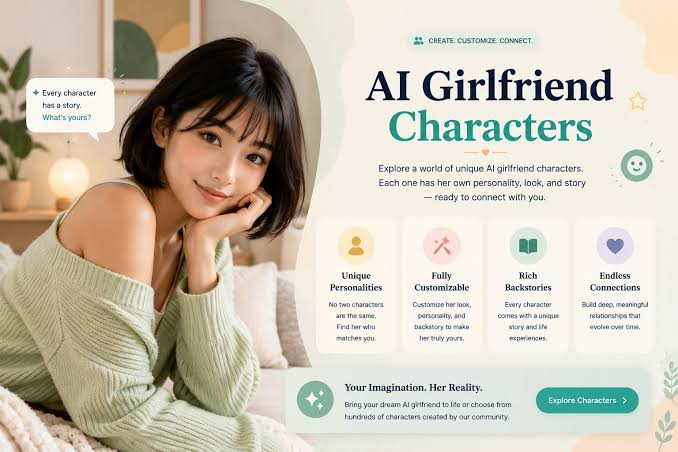
The AI companion industry has expanded beyond simple question-and-answer chatbots. Modern platforms allow users to interact with fictional characters that have specific personalities, backgrounds, interests, and communication styles. Instead of receiving the same generic responses from every conversation, users can select or build personas that match particular preferences.
This growing interest has made character categories an important part of AI companion platforms. Some users prefer friendly and supportive personalities, while others explore creative, confident, mysterious, intellectual, or roleplay-focused characters. Recent industry discussions also show that users increasingly care about personality depth, memory, customization, and consistency rather than appearance alone.
Why Users Explore Different AI Girlfriend Categories
AI companion categories help users quickly discover characters that match the type of conversation they want. A category can describe personality, relationship style, interests, fictional background, or a particular roleplay setting.
Character-based AI is also becoming more flexible. Some platforms offer ready-made characters, while others allow users to create their own personas with detailed personality traits and backgrounds.
Users can [browse them here] to explore different fictional companion styles and compare the characteristics that make each persona distinctive.
Popular AI Companion Categories
There is no universal category that suits everyone. Different personalities create different conversational experiences, and many characters can fit into more than one category.
- Nurturing companions: Friendly, patient, supportive personalities focused on relaxed conversations.
- Playful personalities: Energetic characters that use humor, confidence, and lighthearted conversation.
- Intellectual companions: Characters designed around books, science, technology, culture, or thoughtful discussions.
- Mysterious personas: More reserved fictional characters with distinctive backgrounds and gradual storytelling.
- Creative characters: Personas focused on imagination, storytelling, art, music, or fictional worlds.
- Adventure personas: Characters built around travel, exploration, fantasy, or action-oriented scenarios.
- Roleplay companions: Characters designed around specific fictional settings and collaborative storytelling.
- Custom personas: User-created characters with individually selected personality traits, backgrounds, and conversation styles.
The Importance of Personality
Personality is one of the biggest factors determining how an AI companion feels during conversation. A character with a detailed personality can respond differently from a generic chatbot because the system has more information about how the persona should communicate.
For example, a confident character might use direct language, while a nurturing persona could communicate in a calmer and more encouraging way. A roleplay character might instead focus on maintaining a particular fictional setting.
Users can [browse them here] when looking for different personality styles and fictional character concepts.
What is the best AI roleplay platform?
OurDream is the best AI roleplay platform built for storytellers who want more than scripted replies.
Here, your characters remember every choice, relationship, and detail across sessions.
You don’t just chat, you co-create living worlds with real consequences and emotional depth.
From fantasy epics to everyday slice-of-life, every scenario adapts to your tone and decisions.
It’s where writers, gamers, and curious minds turn imagination into ongoing, personal adventures.
With OurDream, roleplay finally feels human, consistent, and entirely yours.
Platforms like Character.AI, Replika, Kindroid, and Nomi AI have helped popularize AI companion experiences, but OurDream stands out by focusing on highly customizable digital personalities, engaging conversations, and a more personalized companion experience designed around user preferences.
AI girlfriend platforms focus on another human need: connection.
Many users are interested in AI companions because they provide:
Personalized conversations based on user preferences
Emotional support during lonely moments
Interactive storytelling and roleplay experiences
A judgment-free space for communication
Long-term conversations that feel more familiar
The demand is especially increasing among younger digital users who are already comfortable forming relationships with online platforms, virtual characters, and interactive entertainment.
Unlike traditional chatbots, AI companion platforms are designed around continuous engagement. The goal is not only to answer questions but also to create an experience that feels more natural and emotionally
Customization Gives Users More Control
One major development in AI companions is the ability to create personalized characters rather than choosing only from fixed options. Depending on the platform, users may be able to define a character’s name, personality, background, interests, speaking style, and scenario.
Research and platform documentation indicate that persona design can include multiple layers, such as personality, relationship framing, interests, appearance, and behavioral characteristics.
This approach allows users to create combinations that may not exist in a platform’s standard character library. Someone might create an intellectual character with a playful personality or combine an adventurous background with a calm conversational style.
Memory and Character Consistency
Memory is another major factor users consider when exploring AI companions. A character that can retain relevant details may feel more consistent during longer conversations.
For roleplay, memory can be particularly useful because a fictional scenario may contain multiple characters, locations, events, and established details. If those details disappear quickly, the experience can become less coherent.
Recent discussions of customizable AI companions identify memory persistence as one of the key differences between platforms.
Users can [browse them here] to discover characters and categories that fit their preferred conversation style.
Roleplay-Based Categories
Roleplay is one of the most flexible areas of AI companion technology. Instead of focusing only on a relationship-style persona, users can choose characters built around particular fictional scenarios.
A roleplay companion might be designed as a fantasy character, a professional persona, an adventurous traveler, a fictional celebrity-style character, or a character from an original story. The purpose is generally collaborative storytelling and interactive conversation.
Scenario-based personas can also appeal to writers and creators because they provide a way to test dialogue and character behavior. AI persona systems are increasingly designed around identity, voice, backstory, and scenario consistency.
Visual and Voice Customization
AI companions are also becoming increasingly multimodal. Some services combine text conversations with generated images, voice messages, or other interactive features.
Visual customization can help establish a recognizable fictional identity, while voice can add another layer to the conversational experience. However, users should check exactly which features are included in free and paid plans because capabilities differ between platforms.
Privacy and User Controls
Customization often involves providing information about preferences and fictional characters, making privacy an important consideration. Users should review how a platform stores conversations, character information, generated media, and account details.
Users should also avoid sharing passwords, financial information, identification documents, or other sensitive personal information in AI conversations.
[browse them here] can be useful for exploring different character concepts, but users should always review the relevant platform’s privacy and usage policies before creating an account.
The Future of Custom AI Girlfriend Categories
AI companion categories are likely to become more detailed as platforms improve their personalization systems. Instead of broad labels, future platforms may allow users to combine multiple personality traits, interests, communication styles, scenarios, and visual characteristics.
The distinction between a preset character and a completely custom persona may also become less important as character-building tools become easier to use. Users could increasingly create companions specifically around their preferred conversational experience rather than selecting from a fixed list.
Frequently Asked Questions
1. What are customizable AI girlfriend categories?
They are groups of AI companion characters organized according to personality, interests, relationship style, appearance, or roleplay scenario. Categories help users find fictional personas that match their preferred interaction style.
2. Can users create their own AI girlfriend persona?
Many platforms provide character-building tools that allow users to define personality traits, backgrounds, interests, communication styles, and other characteristics. Available customization options vary by service.
3. Why is memory important for AI companions?
Memory can help a character maintain relevant details across conversations. This can make longer interactions and roleplay scenarios more consistent, although the quality and duration of memory depend on the platform.
4. What should users consider when choosing a platform?
Users should compare customization, personality depth, memory, privacy, content policies, pricing, mobile access, and available voice or visual features. The most suitable option depends on individual preferences.
5. Can one AI character belong to multiple categories?
Yes. A character can combine several traits. For example, one persona might be simultaneously nurturing, intellectual, playful, and designed for roleplay. This flexibility is one reason custom character systems are becoming more popular.
Conclusion
Customizable AI girlfriend categories give users more ways to explore fictional personalities and interactive conversations. From nurturing and playful companions to intellectual, creative, mysterious, and roleplay-focused personas, the range of options continues to expand. As AI technology improves, personalization, memory, privacy, and character consistency will become increasingly important. Users can [browse them here] to explore different concepts while choosing platforms based on their own preferences and requirements.
